

Researching With Rachel
Rachel White Roy, MPH, Ph.D.
Rachel became interested in researching the relationship between environmental exposures and poor health outcomes in 2017 while studying for her master's in public health. While studying for her Ph.D., Rachel connected with Achieving Community Tasks Successfully (ACTS) to learn from the organization and engage in environmental justice efforts. ACTS was a perfect fit because her grandparents raised her father in Pleasantville, the community that ACTS primarily serves, and she has spent a great deal of time in Pleasantville throughout her life. Pleasantville has been impacted by pollution and industrial encroachment for many years. Rachel was even exposed to a warehouse fire of toxic chemicals in Pleasantville in 1995. As a board member of ACTS, she provides epidemiology subject matter expertise and analysis skills to help ACTS identify trends in harmful air pollution, assists with their ongoing efforts to hold polluters accountable, and supports disaster preparedness and recovery efforts in the community.
What's in Our Air
To better understand where pollution in their community may be coming from, ACTS applied for and received grant funding to initiate a community air monitoring network. Seven Clarity monitors measuring AQI, PM2.5, and NO2 have been placed in the Pleasantville and Clinton Park areas to monitor the outdoor air conditions in these communities. The goal of this project is to look for trends in air quality and help the Pleasantville and Clinton Park communities monitor their outdoor air exposure and associated health conditions. The analysis includes determining the percentage of time that the community is exceeding the National Ambient Air Quality Standards (NAAQS) yearly and daily standards, determining the percentage of time that the community is exceeding levels that researchers have determined result in poor health outcomes, and times of the day and days of the week when these concerning measurements are occurring to potentially identify the source. The analysis is also meant to inform residents of when their air quality is dangerous and when they should take precautions while outdoors. This information will be updated monthly on the ACTS website.
For questions please email: Rachel@acts-organization.org.
Improving the Quality of Life
ACTS endeavors to improve the quality of life for residents not only in Pleasantville but adjoining communities as well. We will encourage healthy living for multi-generations, identify and implement strategies to improve air quality and reduce exposure to hazardous materials, partner with other agencies for resources and seek solutions for flood mitigation.
Pleasantville identified air quality as one of the top priority
The residents of Pleasantville identified air quality as one of the top five priorities for the community in January 2018. By November 2019, the community-led air monitoring network was being implemented. Today the network consists of a total of 8 low-cost monitors measuring both particulate matter (PM2.5) and nitrogen dioxide (NO2). Monthly reports are generated to document air quality measurements. This information is also available on the website. You can find out more by clicking here.What are some of the advantages/benefits of being able to access this air monitoring information:
- Residents have 24-hour internet access to view the devices.
- Color coding allows easy identification for readings.
- End users can create graphs
- The data has led to the Texas Commission on Environmental Quality (TCEQ) delegated state agency by the EPA is supporting placing a federal equivalent monitor (FEM) in the Pleasantville community by December 2022.
AIR QUALITY IN APRIL 2022
On May 16th readings were as high as 41ug/m3. On May 20th, readings were as high as 37ug/m3. And on May 26th readings were as high as 36ug/m3.
To understand days when the average readings were the highest, the calendar plot below depicts a gradient color for PM2.5 pollution averaged per day. The darker the color, the higher the pollution. The 20th and the 21st had the highest daily averages.
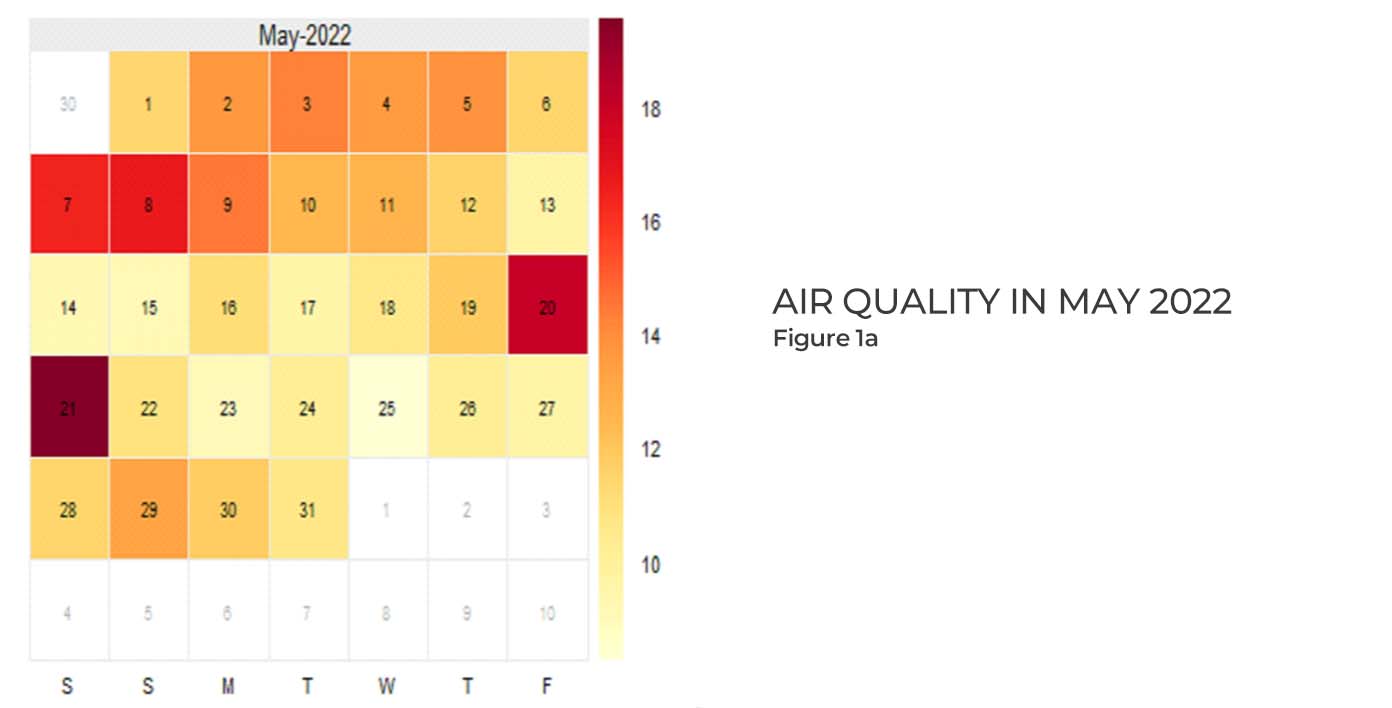
In May ACTS community air monitoring network saw levels above 12ug/m3 45% of the time. This means residents were exposed to air pollution at levels that are considered harmful to health for about half of the month of May.
The Texas Commission on Environmental Quality (TCEQ) reference monitor is compared to the ACTS monitors in the chart below. The TCEQ reference monitor is a regulatory grade monitor meaning the data from these monitors are used to inform air quality and permit violations. This comparison is depicted in the graph below. We have separated the categories of PM2.5 into levels of 0 – 7.99, 8 – 9.99, 10 – 11.99, and above 12 to show the variation between the two monitors.
Figure 3
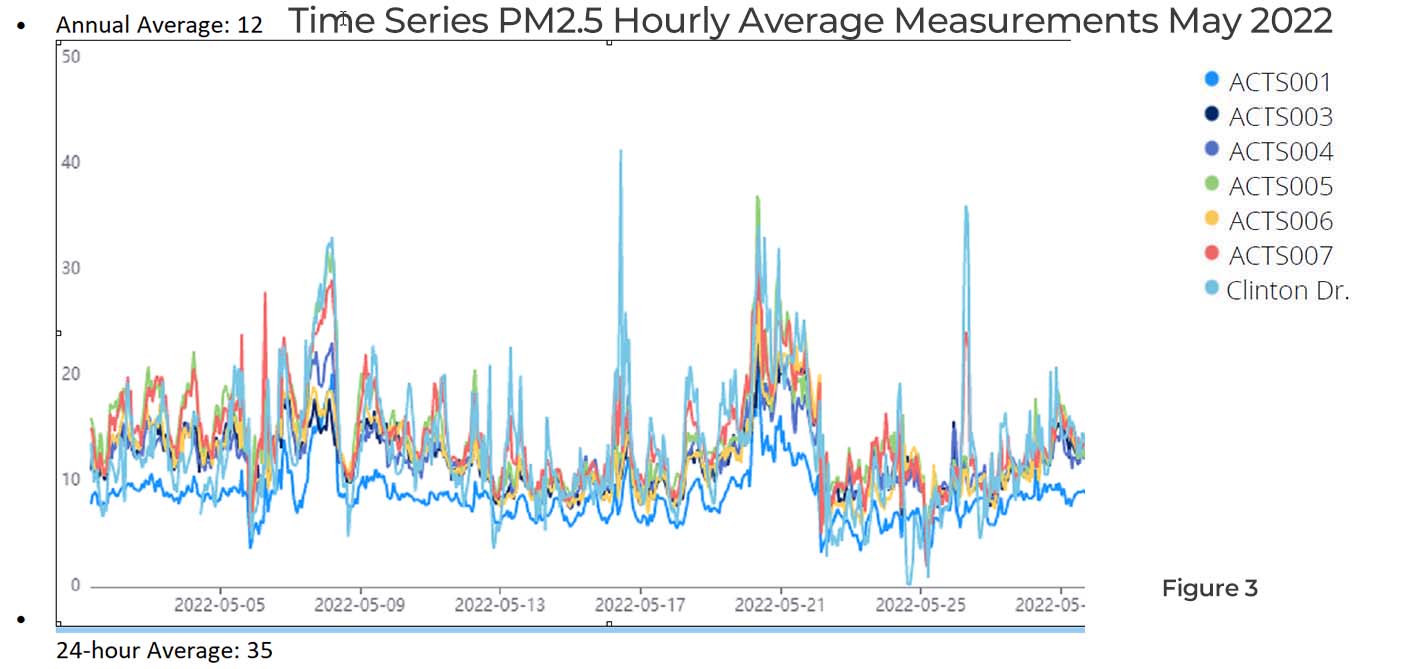
Under the Clean Air Act, the EPA is required to set standards for air pollutants that are considered harmful to human health, PM2.5 is one of those pollutants. The standards that have been set for PM2.5 are:

